Figures released by the German Rubber Industry Association (wdk) in Frankfurt show that significant quantities of ELTs continue to go missing from the collection and recycling system
A secure supply of secondary raw materials is a cornerstone of a resilient and sustainable circular economy for end-of-life tyres (ELTs). However, this supply is still not guaranteed.
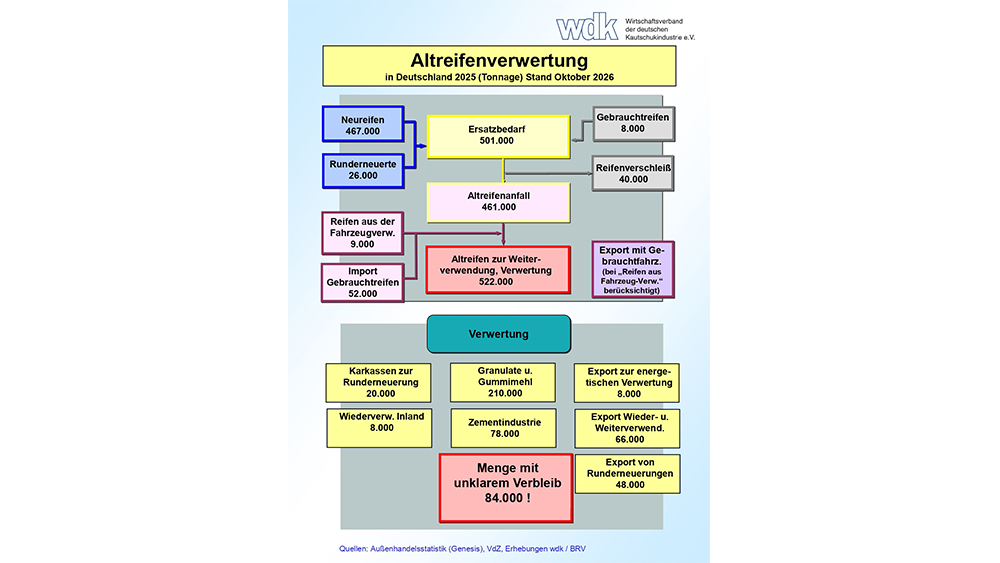
“Last year, around 84,000 tonnes of ELTs had an unknown destination. There is reason to suspect that these tyres, and possibly much larger quantities, were exported to countries outside the EU, where they were burned or subjected to pyrolysis under deplorable health and environmental conditions,” said Stephan Rau, Technical Managing Director at wdk. As a result, these tyres are being diverted away from German recyclers and a sustainable circular economy.
Although the loss rate has fallen slightly, the most effective measure to prevent the loss of valuable secondary raw materials would be systematic recording of the quantities of ELTs generated and the routes through which they are recovered.
“Together with other associations and organisations, wdk has been calling for such an approach for several years. It would be straightforward to implement and would significantly strengthen the circular economy. What is needed, however, is the political will to support and promote a functioning recycling system,” Rau said.
He also pointed to the newly published statistics, which show that Germany generated a total of 522,000 tonnes of ELTs in 2025. Of this amount, 210,000 tonnes were processed into granulate and rubber powder, almost three times the volume recovered for energy in the cement industry.
“This is an extremely positive development and compelling evidence of progress towards a circular economy for tyres,” the association representative said. However, comprehensive tracking of tyre volumes would make it possible to direct even more ELTs towards material recovery.