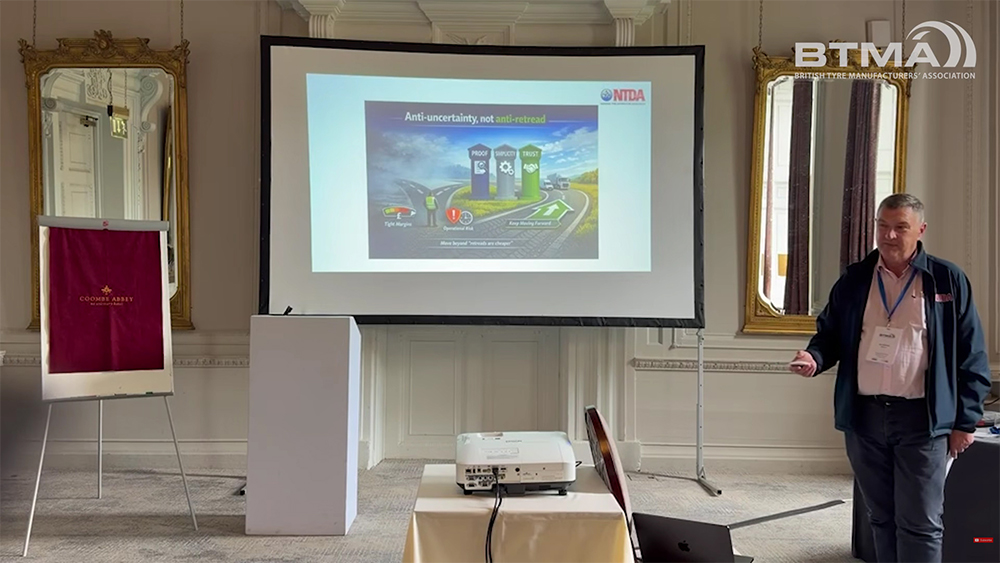
At the TRA Briefing Day, Ian Andrew, CEO of NTDA, gave a speech about the responsibility of tyre retailers for the waste they create. His main message was simple: the duty of care must not stop when the collection lorry leaves the yard
Passive Leadership
Andrew explained that the NTDA sits “right in the middle” of the tyre economy and supply chain. Its members fit much more than passenger car tyres, since the full range includes commercial, industrial and specialist tyres. Every fitted tyre produces a waste tyre, so a level of ownership is necessary.
In his opinion, leadership in the retail sector is currently “quite passive.” Many fitters know that someone will arrive regularly to collect their waste tyres, and for them the responsibility ends there. “They don’t necessarily see themselves having any degree of ownership or interest beyond them being collected, and I think that’s where it needs to change,” Andrew said, explaining that the duty of care should continue from the gate of the depot all the way to final disposal, whatever form it takes.
He also acknowledged that the large retail groups usually employ environmental specialists and are better prepared for this task. The difficulty is the long tail of small businesses and sole traders in the fitting sector, where this expertise often does not exist.

Digital Waste Tracking is Not a Silver Bullet
Andrew welcomed digital waste tracking and said he would introduce it, but he was realistic about its effect. “It will increase visibility, improve accountability and may reduce some illegal dumping. However, it will not change behaviour,” Andrew explained. In his view, many people see it only as paperwork moved to a computer, and the real problem is that retailers must care about what happens beyond their depot.
Andrew’s practical proposal is that “members should not only audit themselves but also audit the whole supply chain after the tyres leave. They should not simply accept the word of the collector,” explaining that this will be the NTDA’s Environment Sustainability Working Group’s next paper. He also admitted that such change will not happen overnight, as retailers are used to “waving goodbye” to their tyres as they’re collected, saying that their “interest stops there.”
Commercial Decisions and Remanufacturing
Andrew also raised the question of whether retailers create waste through their own commercial choices. During The British Tyre Manufacturer’s Remanufacturing and Safety Forum the day before, he was challenged on this point. Retailers often fit cheap, single-life tyres because the margin is higher, and owners, shareholders and private equity firms expect quick returns.
This matters because tyre retreading in the UK has declined by 50% in only a few years, even though many tyres are designed to be remanufactured. Andrew asked why the single-life option is still chosen so often, believing that retailers should prefer tyres with the potential for several lives, as long as customers still receive good value for money.
Reassessing the Green Fee
Andrew also spoke about the environmental, or “green” fee that many retailers charge for disposing of waste tyres. In his view, it is not always clear what this money is used for. “You cannot expect someone to pay a green fee and not be able to tell them the whole story of what that fee is being used for,” he said. He added that the explanation customers receive today, that the government requires the tyres to be collected, is not strong enough for consumers who are increasingly aware of environmental issues.
Andrew asked whether the existing fee could become the basis of a wider system, similar to models already in place in other countries. “Can we increase that green tariff slightly, and start to gather it in a central place?” he asked. The money would cover the retailers’ disposal costs, but it would also build a fund for new technologies and processes, and for removing the barriers to better end-of-life solutions. “It is happening elsewhere; it is doable,” he said, although he was not sure how much appetite there is for the idea in the UK, saying that it is “certainly worth exploring.” He explained that the industry hears about good initiatives every year, but real progress is slow, asking whether a central fund led by retailers could help to move things forward.
Data, Communication and Policy
Retailers already hold a lot of data, and Andrew believes they should use it better, both for decisions about fitting and for waste tyres. Staff should also be able to explain what happens to a tyre, when it reaches end-of-life, so that a green sticker is not just “slipped on” without any information behind it. Consumers, whether private or commercial, are becoming more environmentally aware and expect a stronger story.
Moving on, he spoke about the UK’s limited options for end-of-life tyres. If India is the only viable destination at the moment, then retailers can at least be confident about where their tyres go. But better domestic alternatives are needed, and retailers should support them. For this, the industry needs political stability and clear policy, with Andrew saying the trade associations such as the NTDA, TRA and BTMA should work together on a common “tyre manifesto” that states what the sector does well and what it wants changed.
Five Actions for Retailers
To close, Andrew said that the NTDA will encourage its members to take five main actions. Firstly, retailers should embrace traceability and follow their tyres. Second, they should choose compliant partners, so that they know exactly where their end-of-life tyres go. Third, they should train their staff so that everyone in the business has the right information about waste and end-of-life tyres. The fourth action focuses on informing customers, because, as Andrew explains, a green sticker alone is not enough and customers should hear the full story behind the fee they pay. Finally, retailers should champion sustainable tyre recovery by supporting better solutions such as remanufacturing and new domestic alternatives.
Andrew was clear that this requires a change of mindset and that such a change “doesn’t happen overnight,” hoping that when he returns next year, the industry will be able to report some real progress and a shift in thinking.