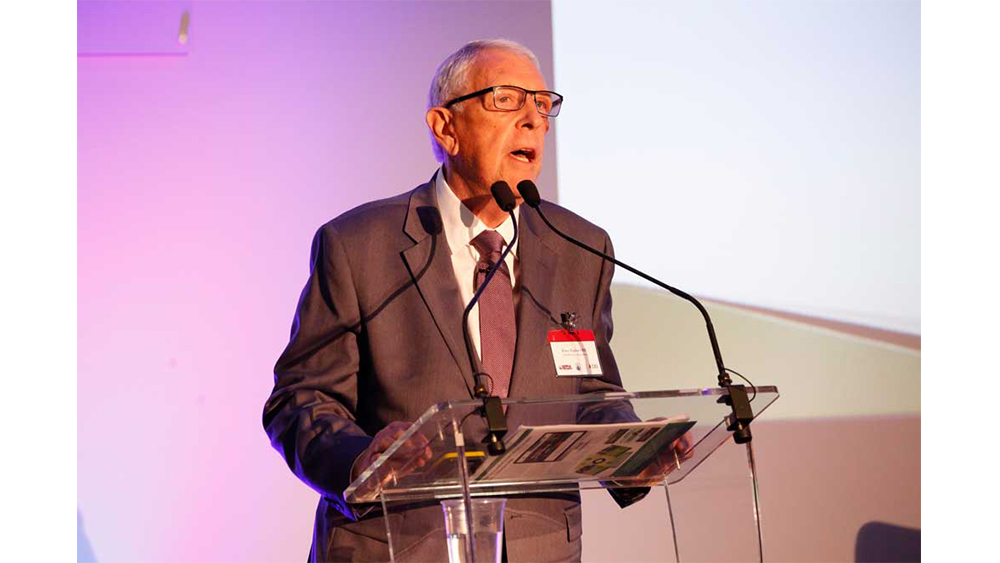
Dr Chris Crozier is a long-standing member of South Africa’s REDISA. Crozier was moved to comment on the Rhode island article. We decided to reproduce Crozier’s comments in full below:

The recent article titled Rhode Island Challenge highlights why we are getting no closer to solving the waste tyre challenge. The indicators are epitomised by three quotes picked from it:
D’Ambrosio comes to the reality of the challenge. The problem, he writes, is the fact there are limited markets for recycling them.
Shaina Cohen, program manager for hazardous waste and waste site cleanup for the Northeast Waste Management Officials’ Association: “Other recycling options are either limited in capacity or not economically viable at scale. … Emerging technologies such as pyrolysis … are being explored”
Don D’Ambrosio: “People see (tyre pyrolysis) as the next big thing, but when you look at pyrolysis facilities you can’t find one that operates economically for a long period of time”.
The article quotes people who are well versed in the field. They should be getting to the heart of the problem and pointing the way to solutions, but like almost everyone else in the field the core issue is, with respect, being missed.
The false promise of pyrolysis
First, as a preamble, pyrolysis is hardly an emerging technology: it has been around for decades with no success, and as nations become more aware of the environmental side effects of pyrolysis it is becoming harder to make it economically viable. Even as small gains are made in the processes, increasing environmental awareness and controls make it more costly to operate these plants. D’Ambrosio is right to point out that with our current technology it is difficult (arguably even impossible) to make money at it. The evidence of failure is incontrovertible: there are myriad pyrolysis operations being commissioned, and failing, in almost every country in the world. Waste tyres are a problem in every country in the world. If it were possible to make money out of pyrolysis, or indeed any waste tyre recycling process, then waste tyres would be a resource that entrepreneurs would be competing for.
The fact is starkly simple: no-one has yet found a way to make money out of recycling tyres.
Recycling is not profitable. Now what?
This does not mean we should shrug and say “too bad, let’s just dump them, or burn them and hope we can get away with it”. The negative effects of unmanaged waste tyres hardly need explaining to the readers of Tyre and Rubber recycling: environmental pollution (especially when a fire breaks out at a dump), landfill depletion, and the many other incidental consequences all mean we cannot ignore the problem. What it does mean is that we should stop clinging onto the mystical idea that waste tyre are a valuable resource and the failure is in the resourcefulness and technological skills of the processing industry.
We need to voice clearly that dealing with waste tyres is not a local economic challenge. We have to look at the macro-economic picture: what is the cost to society of failing to deal with waste tyres? And then we have to find a way of dealing with waste tyres that is less than this cost.
It will require funding to be put into the system. You may call it a processing subsidy, but that is an unfair characterisation. The real subsidies are that we allow people to get the benefits of using tyres without carrying the costs of proper disposal, recycling or recovery. The utility that tyres bring to modern life is enormous, facilitating transport of goods and people throughout the economy. The article mentions tyre disposal charges of $3 to $5, which may seem like a lot of money, but put it into context. Suppose a passenger car carries a cost of $5 per tyre, $20 in all, and assume a tyre life of 20,000 miles. That works out to $0.001 (0.1c) per mile travelled. That is a trivial cost. If you scale that up 200-fold for a 16-wheeler with truck tyres it is still only $0.20 per mile travelled, and much less if tyres are retreaded. How can anyone argue that this is too high a price to pay for preventing waste tyre pollution?
$5 for a passenger tyre equates to around $0.50/kg. Applying that to all the scrap tyres in the US, for example, gets you to about $2 billion per annum (for the UK, the numbers work out to about $250 million, or £180 million per annum). If we poured that amount of money into a coordinated effort across the value chain, addressing not only collections but everything from researching better ways to make tyres last longer and be easier to recycle, through developing better recycling technologies, we could realistically expect to get somewhere.
Many will recoil at any suggestion of spending that much money annually to deal with waste tyres, not thinking of the trillions in economic activity the tyres enable and the minuscule impact we are talking about, and that is before considering the benefits that would flow from a waste tyre recycling industry that worked.
Managing the money
It is possible to set up a system that does this. There was one in South Africa under REDISA which ran successfully from 2013 to 2017 until it fell afoul of refusing to participate in corruption. REDISA’s principles were simple, based on an EPRO that operated independently of the tyre industry (this is important, since some of the obvious steps, such as extending tyre life, go against the short-term commercial interest of producers). The EPRO collected a fee per kg of tyres produced from all tyre producers and applied it to establishing a national system for the collection, aggregation and re-delivery of waste tyres to processors. Processors received processing fees, and more importantly, assured supplies of feedstock to provide a stable investment environment. R&D projects were funded to investigate processing technologies and secondary market opportunities.
A key development that was planned, but derailed by events, was to develop differentiated fees based on tyre life cycle analyses, a concept called Environmental Ratings. Tyres with a better Environmental Rating would pay reduced waste management fees. This would provide positive incentives for producers to work on reducing the environmental impact of their tyres, thus directly rewarding them for making tyres that are longer lasting, less harmful to the environment, and easier to recycle. Such a direct incentive would mobilise R&D on the part of the real experts in the field, the people who know their products inside out. If the industry could save, say, 20% on their waste management fee that would in the US market mean saving $400 million per annum. Those who led the field would gain financially and get a competitive advantage.
Who pays?
To be clear, the EPRO model is one where ultimately the user (the ultimate polluter) pays. The producers are just the collection agents. In principle, you could apply charges at the retailer instead of at the producer. In practice, though, instead of collecting fees from a few thousand entities in the US (it was about 200 in South Africa), you would be collecting from tens of thousands of entities, with disproportionately greater challenges of gathering and auditing the process and the inevitably high ‘leakage’. If you collect from the producers the costs will filter through to the users. There’s nothing wrong with that: end of life management is just another cost of production.
The “magic bullet” here is a co-ordinated approach with the net benefit to society at its centre, insulated from vested interests. It brings some options that would not be possible otherwise. Suppose, for example, that a new way of processing rubber is developed that offers longer life and better re-use opportunities, but implementing it would result in investments in existing processes becoming obsolete, resulting in stranded capital. Manufacturers would be reluctant to write off those investments, but some of the billions being collected in waste management fees could be applied to fund plant replacements.
In the meantime, without a coordinated plan, we will continue on the treadmill of building tyre recycling plants, trying to operate them profitably, closing them down, then repeating the cycle time and time, place and place again.