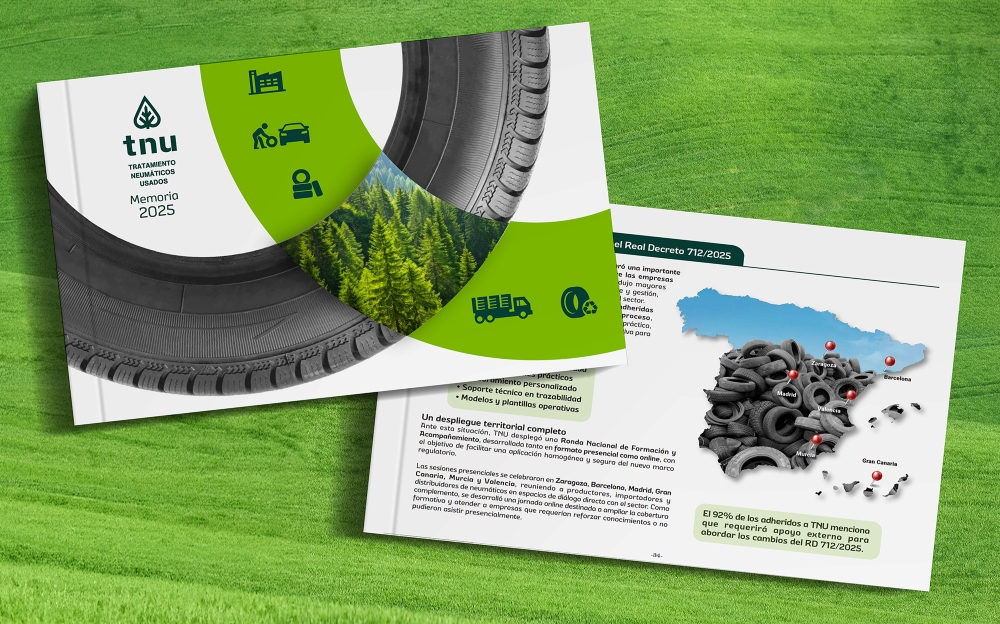
Tratamiento Neumáticos Usados (TNU) published its 2025 Annual Report, showing 98,933 tonnes of end-of-life tyres managed in 2025, which is a 7.4% increase compared to 2025
TNU operates as one of Spain’s official industry-run compliance schemes for tyre producers, a SCRAP (Sistema Colectivo de Responsabilidad Ampliada del Productor), which in 2025, processed 98,933 tonnes of end-of-life tyres, a 7.4% increase on the year before, as it worked to keep the sector’s waste management efficient and accountable while helping producers, treatment operators and collection points adjust to the incoming rules.
To put the scale in perspective: the volume handled is roughly equivalent to 9.38 million individual tyres, about one for every five people in Spain. TNU served 5,510 collection points nationally and responded to 42,910 pickup requests, run through its network of producers, waste operators and collection sites across the country.
TNU’s figures show it followed the waste hierarchy set out in EU and Spanish law, the principle that reuse should always be tried before recycling, and recycling before burning for energy. Of everything collected in 2025: 9.94% was reused outright (4.69% resold as-is for continued use, 5.25% retreaded and put back into service); 42.91% was recycled into raw material; and 47.15% was burned to generate energy. Reuse sits at the top of that hierarchy because it’s the option that most directly cuts demand for new tyres — and with it, the raw materials and energy that go into making them.
The single biggest development of the year was Royal Decree 712/2025 taking effect, according to TNU, which represents new rules that tighten what producers and compliance schemes like TNU must do around traceability (tracking exactly where tyres end up), oversight, transparency, and hitting specific targets for how much gets reused, recycled or recovered.
To help the industry adjust, TNU spent 2025 upgrading its internal tracking and reporting systems and ran training and outreach for producers, waste operators and other players in the sector, aiming for a smooth, consistent rollout of the new rules across the industry.
One notable highlight: TNU worked alongside SIGNUS, a sister compliance scheme covering the rest of the Spanish tyre market, as part of the Valencian regional government’s response to the DANA, the catastrophic flash-flooding event that hit the region, helping manage the huge volume of tyres swept up in the flooding. It was a real-world test of how quickly the system could mobilise outside its normal routine.
Juan Ramón Pérez, President of TNU, said: “Royal Decree 712/2025 has marked a turning point for the sector. Greater traceability, digitalisation and new obligations for producers, waste managers, collection points and collective compliance schemes will improve both transparency and efficiency. Throughout this transition, TNU has worked closely with the sector through information, training and active dialogue to support adaptation to the new framework. We remain committed to providing a robust, reliable management system capable of meeting the challenges of the circular economy.”