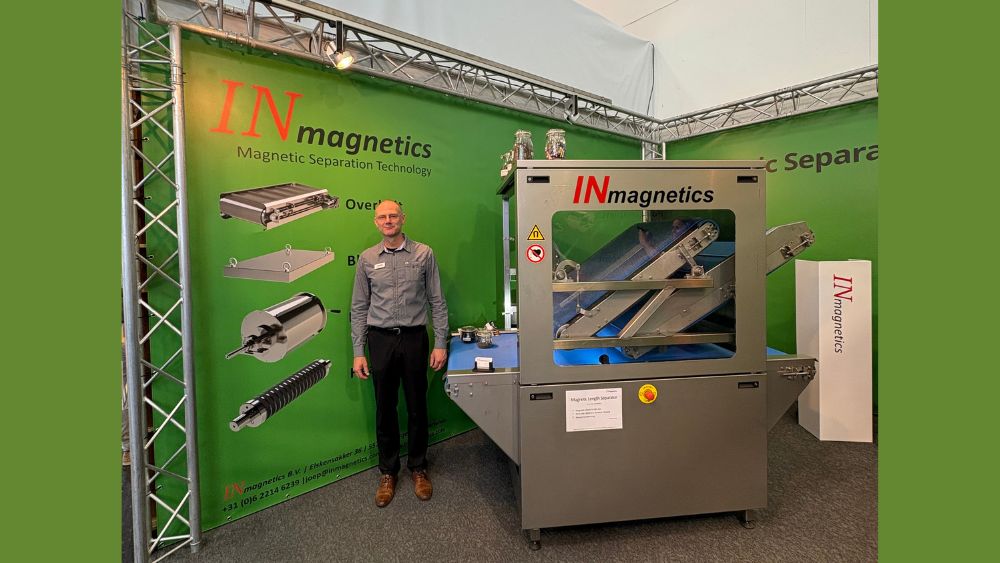
At IFAT 2026, Dutch technology company INMagnetics presented a new approach to one of the challenges facing tyre recycling: how to consistently sort steel recovered from end-of-life tyres so it can move beyond scrap applications and into higher-value reuse
Founded by Joep Spithoven in 2019, INMagnetics focuses on magnetic solutions designed to improve the recovery and quality of secondary raw materials. The company’s latest development, the Magnetic Length Separator (MLS), uses magnetic fields to separate ferrous materials according to their length — opening new possibilities for applications where consistent material specifications are essential.
The idea behind the technology came from a conversation with a tyre recycler who was looking for ways to supply recovered steel wire to the concrete industry.
While steel recovered from waste tyres is commonly separated during shredding and sold as scrap metal for remelting, the material itself has properties that could allow it to be reused. Tyre reinforcement steel is designed to withstand extreme forces, protecting vehicles and passengers at high speeds and under heavy loads.
“For applications such as concrete reinforcement, you need a reliable and repeatable quality,” explains Spithoven. “The steel fibres coming from tyres are strong, but they need to be classified according to size before they can be considered as a controlled input material.”
This challenge led to the development of the Magnetic Length Separator.
The MLS technology separates continuous flows of ferromagnetic material based on length. Instead of relying on screens or mechanical sorting methods, the system uses permanent magnets to orient and transport steel objects through a controlled magnetic field.
Once inside the machine, magnetic steel fibres are positioned vertically. Their length determines whether they pass through the separation gap or are redirected into a different output stream.
The separation size can be adjusted according to customer requirements, allowing operators to define what qualifies as “short” or “long” material.
According to INMagnetics, the technology is designed to be robust, scalable and suitable for continuous industrial operation, while requiring limited maintenance thanks to the use of permanent magnets.
By creating a more controlled classification process, INMagnetics believes tyre-derived steel fibres could find new applications, including reinforcement materials for concrete and composites.
“Reuse instead of remelting is the idea,” says Spithoven. “If you can define the quality and create a consistent classification, you create a material that can be used again.”
Steel fibres currently used in concrete reinforcement are often manufactured from new steel. According to INMagnetics, tyre-derived fibres could provide an alternative secondary material while reducing demand for virgin resources.
Although the MLS was initially developed with tyre recycling in mind, INMagnetics sees potential across several industries.
The system can also be adapted for applications such as removing length-specific metal objects from waste streams, improving shredder output quality, reducing manual sorting requirements and protecting downstream equipment.
The company is also exploring applications in other recycling sectors where the physical length of magnetic materials determines their value or usability.
Looking ahead, INMagnetics is actively seeking strategic partnerships to commercialise the technology. The unit showcased at IFAT 2026 was developed for a prospective client following extensive prototyping and testing.
After a successful debut at a local trade event last year, the company utilised IFAT to introduce the MLS to a global audience. Spithoven confirms that the company is currently open to various forms of commercial collaboration to establish a structured sales and distribution strategy for the recycling market.
For Spithoven, the wider goal is clear: developing practical technologies that help industries recover more value from existing resources.
With the Magnetic Length Separator, INMagnetics aims to help recyclers move from simply recovering materials towards creating higher-quality secondary resources — a key step in building a more circular industrial economy.