












One of the elements of any modern pyrolysis process is the delivery of the end product in a format that is transportable. In most cases this is in a bagged pelletised format
The output of the pyrolysis process, will be milled to create a fine powder, and all non carbon materials removed – small fragments of steel or stone that have gone through the process.
For the purposes of this article, we will refer to the powder arising from pyrolysis as recovered carbon black – technically speaking the output of pyrolysis is a carbonaceous char that needs refining to become rcb, in most cases..
Recovered Carbon Black (rCB) is becoming a sustainable alternative to virgin carbon black, particularly in rubber, plastics, and ink production.
In order to pelletise the rcb powder, the material is dampened to enable it to be pressed into pellets that can be bagged and transported.
The rCB must be dried safely and uniformly before reuse. Given the combustibility and explosive nature of fine carbon black dust, drying must comply with ATEX and/or NFPA regulations.
Given the nature of the material, it has to be handled with care.
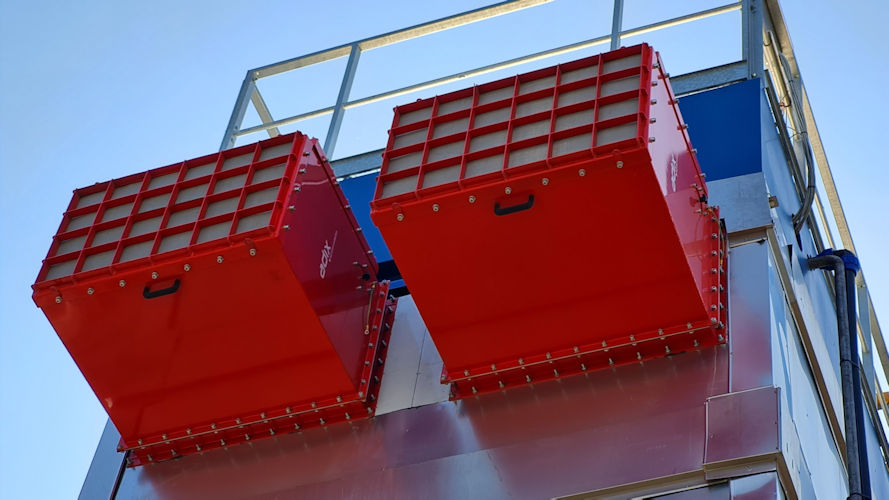
TEMA Process, a global leader in thermal drying technology, offers advanced fluid bed drying systems equipped with comprehensive explosion protection and high energy efficiency, ensuring safe operation and reduced operational costs.
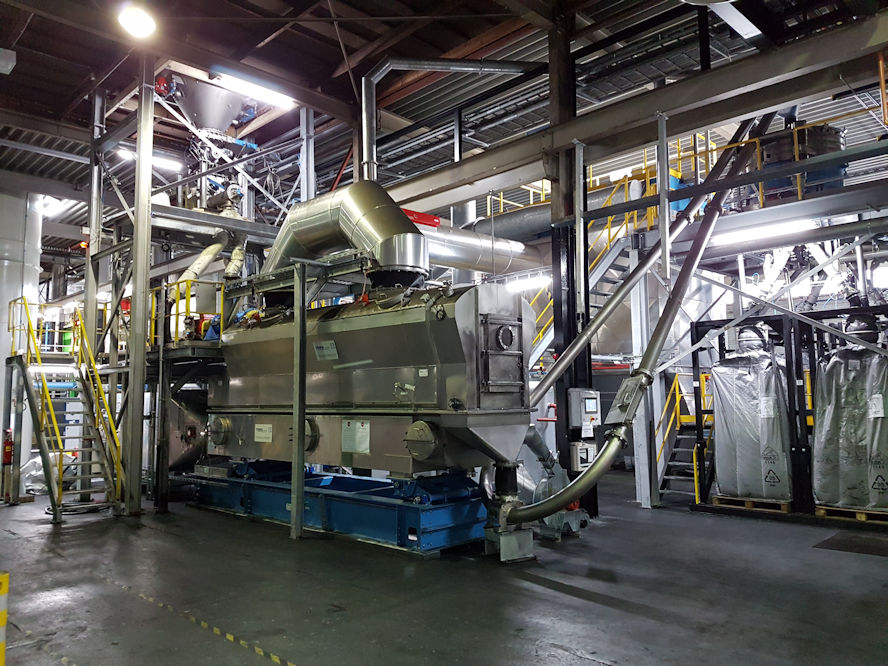
The gentle drying process in a TEMA Process fluid bed dryer is specifically designed to handle fragile, granular or pelletised materials — such as recovered Carbon Black (rCB) pellets — that are sensitive to mechanical stress, high temperatures, or sudden movement. The goal is to remove moisture uniformly and carefully, without causing degradation, fines formation, or breakage of the product.
How It Works
1. Fluidisation with Low-Velocity Air
The core of the drying process is fluidisation: warm air is blown upwards through a perforated plate, gently suspending the product in a semi-floating state. The rCB pellets “float” and move in a controlled, cushioned air stream, which minimises mechanical contact and abrasion.
- The drying air is typically heated to no more than 170 °C, ensuring that thermal stress on the product remains low.
- The fluidisation velocity is finely tuned to balance effective drying with minimal product disturbance.
2. Shaking Mechanism for Gentle Transport
TEMA’s shaking fluid bed dryer is equipped with a mechanical shaking system that provides gentle, horizontal movement of the product across the bed.
This avoids the use of rotating paddles or internal mechanical agitators, which can damage soft or friable materials.
- The shaking motion allows uniform residence time, ensuring each pellet is exposed to the same drying conditions.
- The motion is continuous and smooth, helping to prevent agglomeration, channelling, or local overheating.
3. Even Heat and Mass Transfer
Because the product is fully and evenly exposed to the drying air:
- The drying process is highly uniform, avoiding over-drying or under-drying zones.
- The drying rate is controlled and consistent, which protects material structure and preserves physical properties.
4. No Mechanical Shear Forces
Unlike rotary dryers or mixers, the fluid bed design applies no shear forces. Pellets maintain their original size, shape, and density, which is critical for downstream applications like rubber compounding or plastics.
Specific Benefits for rCB Pellets
- Prevents pellet breakage and dust formation
- Reduces fines content, resulting in a cleaner, higher-quality product
- Improves product consistency, critical for technical specifications
Optional Features to Enhance Gentle Drying
- Cooling section after drying to stabilize the product temperature
- Dust extraction system to remove only ultra-fine particles (<100 μm)
- Adjustable shaking intensity based on product fragility
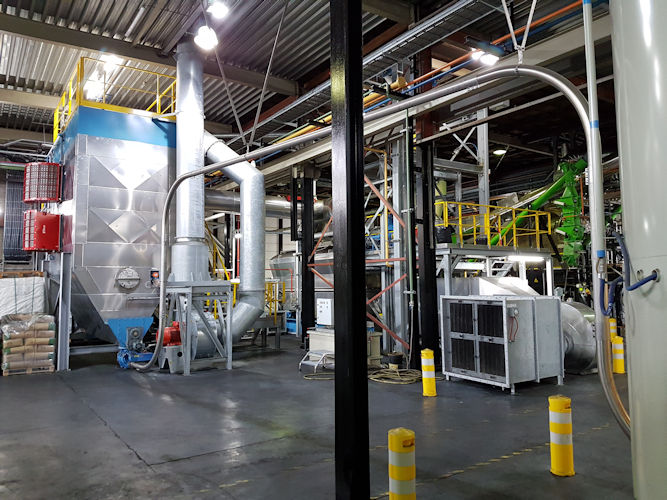
As with all technologies today, manufacturers have to look for the most efficient use of energy and with THEMA Process, energy efficiency is a key design objective in modern drying systems. TEMA Process integrates heat recovery systems on the exhaust airline to significantly reduce energy consumption:
How It Works
- The hot exhaust air from the fluid bed dryer or pyrolysis contains recoverable thermal energy.
- This air passes through a heat exchanger, where energy is transferred to the incoming fresh air stream or process air loop.
- Preheated air then requires less additional heating, reducing the load on the burner or heater.
Key Benefits
- Energy savings up to 15–70% depending on process conditions.
- Lower fuel consumption, reducing operational costs.
- Reduced CO₂ emissions, contributing to sustainability goals.
- Improved overall thermal efficiency of the drying line.
This feature is especially valuable in continuous rCB processing lines, where drying is one of the most energy-intensive steps.
Safety is Critical
Drying circular Carbon Black (rCB) — a fine, powdery substance recovered from pyrolysed rubber such as end-of-life tyres — involves handling a material that is both combustible and potentially explosive in dust form. Due to its physical and chemical properties, the drying process must be designed with a strong focus on explosion prevention and fire safety.
This is why ATEX compliance, spark detection systems, and automatic fire extinguishing are not optional — they are essential.
1. rCB Dust Is Explosive
When fine carbon black dust is suspended in air, it can form an explosive atmosphere. If an ignition source is present, a dust explosion can occur.
2. ATEX Classification Is Mandatory in the EU
ATEX (Atmosphères Explosibles) directives are European regulations for equipment and protective systems intended for use in potentially explosive atmospheres.
In the case of rCB drying:
- Inside the dryer and dust filter: classified as ATEX zone 22/21. (likely presence of dust cloud)
- Surrounding areas near flexibles or outlets: Zone 22 (occasional dust presence)
- All electrical and mechanical equipment (motors, valves, sensors) must be ATEX-certified to prevent ignition from sparks or hot surfaces.
3. Spark Detection Prevents Ignition at the Source
Even a small metal particle, static discharge, or hot surface can ignite cCB dust. To prevent this:
- Infrared spark detectors (e.g. Firefly True IR) continuously monitor the airflow inside the dryer and exhaust ducts.
- When a spark or hot particle is detected, the system:
- Triggers water spray nozzles to extinguish the ignition source.
- Sends an alarm or initiates an emergency shutdown.
- This intervention happens in milliseconds, crucial to stopping a potential fire or explosion before it escalates.
4. Fire Suppression Is the Final Line of Defence
In addition to preventive measures, an automated fire extinguishing system is vital:
- Water spray nozzles are installed in the dryer hood and exhaust air filter.
- These are connected to:
- Electric actuated valves
- Manual override valves
- The system ensures:
- Fires are extinguished immediately.
- The dryer cannot start if water pressure is insufficient.
- A controlled shutdown occurs during fire scenarios.
5. Static Electricity Can Also Be an Ignition Source
Due to the insulating nature of carbon black:
- Surfaces can build up static charge.
- Discharge can occur if not properly grounded.
- All equipment must be earthed to prevent electrostatic ignition.
- Anti-static materials and conductive gaskets are used in flexible connections and filter